Repair What Is Damaged
Show us what is wrong with your fence.
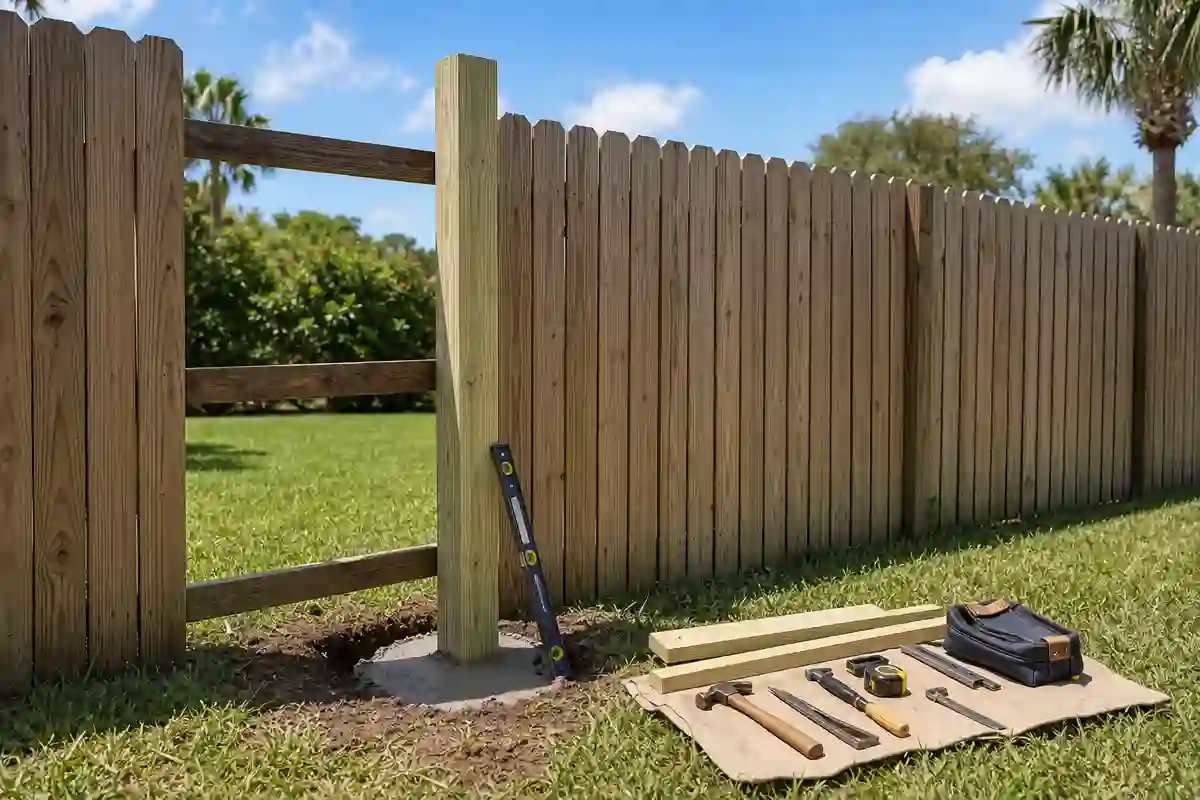
Fence Repair Jacksonville Fl provides fence repair throughout Jacksonville and nearby communities for wood, vinyl, chain link, gates, and storm-damaged fencing. Fence problems rarely stay isolated forever: a loose post can cause rails to pull away, a broken rail can let pickets twist or fall, and one leaning section can place extra pressure on the panels beside it. Our general fence repair service is for situations where your fence has one or several problems and you need someone to determine what should be repaired first.
We begin with the visible damage, then look at nearby components that may be contributing to it. The goal is to restore stability and everyday function without replacing sound sections unnecessarily. If you have a fence that is leaning, separating, missing boards, moving in the wind, or simply no longer working the way it should, tell us what you are seeing.
A good fence repair starts with understanding why the fence failed. Replacing one broken board will not solve a post that is moving underground, and tightening a gate hinge will not last if the hinge post is leaning. We look at the damaged area as a small system: posts support rails or panels, rails hold boards or fabric in position, hardware keeps connections tight, and gates place repeated moving loads on their posts.
Leaning fence sections are one of the most common problems. The cause may be a deteriorated post, loose footing, saturated soil, impact damage, tree-root pressure, or several smaller issues working together. Depending on the condition, a post may need to be reset, reinforced, or replaced before the fence section can be brought back into alignment.
Loose and missing boards are common on wood fencing, especially after long periods of sun and rain. We check whether the individual board failed or whether the rail behind it has deteriorated. When neighboring boards and rails remain serviceable, targeted replacement can restore privacy and appearance without rebuilding the entire run.
Separated rails, loose fasteners, and damaged connections can create movement even when the posts are still solid. These problems are worth addressing before repeated movement enlarges fastener holes or damages surrounding components. A smaller repair performed earlier can sometimes prevent a larger section from loosening.
Posts receive particular attention because so many other fence problems begin there. A fence may look crooked because a panel moved, but it may also be following a post that has shifted at ground level. We check for movement, deterioration, cracking, and visible signs that the post or footing is no longer providing proper support.
We also look at transitions, corners, and gate openings. These areas experience different forces than a straight fence run. Gate posts carry moving weight, corners are pulled in more than one direction, and changes in grade can affect panel alignment. Repairing these areas correctly may require more than simply replacing the visibly broken piece.
Not every aging fence is a good candidate for piecemeal repair. If deterioration is widespread across many posts, rails, and panels, we will explain why repeated small repairs may provide poor value. On the other hand, when most of the fence still has useful life, targeted work can be a sensible way to restore function and extend the service life of the installation.
Jacksonville weather is part of the repair picture as well. Heavy rain can soften soil around already weak posts, humid conditions can accelerate deterioration in vulnerable wood, strong sunlight can affect exposed materials, and storms can turn branches and yard debris into sudden impact hazards. We take those conditions into account when deciding how to stabilize a repaired section.
The easiest way to start is to describe the fence material, the type of damage, and roughly how much of the fence is affected. From there, we can plan the next step and determine what needs a closer look.
Sometimes. Repairing isolated components may cost less than replacing an otherwise serviceable fence, but the right choice depends on how much of the structure remains sound. We compare the damaged area with the rest of the fence before recommending a scope.
We evaluate the posts, footings, rails, connections, and surrounding ground to find the cause of the lean before realigning the affected section.
Post repairs may involve stabilization, resetting, or replacement depending on deterioration, movement, impact damage, and the condition below ground.
Loose or broken structural members can affect several neighboring components, so we repair the support problem along with visible damage.
Individual boards or pickets can often be replaced when the rails and surrounding fence remain in useful condition.
We check fasteners, brackets, hinges, latches, and connection points where movement has made a fence feel loose or unstable.
| Service | Estimated Cost | Average |
|---|---|---|
| Minor board or hardware repair | $125–$350 | $225 |
| Single post repair or replacement | $200–$500 | $325 |
| Small fence section repair | $350–$900 | $600 |
| Multiple damaged sections | $800–$2,500+ | $1,400 |
Typical planning ranges. These are general planning ranges, not quotes. Material, access, damage severity, matching requirements, post conditions, and repair size can change the final price.
We look beyond the most obvious broken piece so the repair addresses the underlying cause when possible.
When surrounding sections remain serviceable, we focus the work on the damaged components instead of automatically recommending replacement.
You get a straightforward explanation of what appears repairable and what may be nearing the end of its useful life.
Describe the fence material, visible damage, and how much of the fence appears affected.
We assess posts, rails, panels, fasteners, ground conditions, and nearby components that may influence the repair.
We identify the components that need attention and explain whether targeted repair makes sense.
Damaged components are repaired, reset, adjusted, or replaced as appropriate for the condition.
We review stability, alignment, connections, and gate operation where relevant before wrapping up.
Start with our wood fence repair, vinyl fence repair , and chain link fence repair pages for material-specific guidance. Gate problems are covered by fence gate repair, while storm-related issues are covered by storm damage fence repair. If repair no longer makes sense, compare those options with our fence installation page.
Repair rotted posts, broken pickets, loose rails, leaning sections, and other common wood fence problems.
Repair cracked panels, loose rails, leaning posts, damaged sections, and problem vinyl fence gates.
Restore bent, loose, sagging, damaged, or separated chain link fencing and gates in Jacksonville.
Fix sagging, dragging, sticking, misaligned, damaged, or difficult-to-latch fence gates.
Repair fences damaged by Jacksonville wind, falling limbs, debris, saturated soil, and severe weather.
Fence Repair Jacksonville Fl is proud to serve Jacksonville and the surrounding communities of Northeast Florida:
Often, yes. The cause may be a deteriorated post, loose footing, saturated soil, impact damage, or tree-root pressure. Depending on the condition, a post may need to be reset, reinforced, or replaced before the fence section can be brought back into alignment. In Jacksonville, saturated soil after heavy rain is a frequent contributor, so the assessment always includes the footing and the ground around the post, not just the visible lean. Addressing the cause first is what makes the repair hold.
Yes, when the rest of the section remains sound, one fence post can often be reset or replaced without replacing the whole fence. We check the post for movement, deterioration, cracking, and footing failure, including below the soil line where rot may start. Rails and boards attached to the post are removed and reattached as part of the repair, and we also inspect the neighboring connections because one failing post can put extra load on the sections around it.
Cost depends on the fence material, the number of damaged components, access, post conditions, matching requirements, and the amount of labor involved. A small hardware or board repair is very different from rebuilding several storm-damaged sections, so an inspection gives a more useful estimate. The planning ranges shown on each service page are general guides, not quotes. After an on-site assessment we provide a clear, itemized scope and a firm price before any work begins — and the estimate itself is free with no obligation.
Do not let one weak section put more strain on the rest of the fence. Start with a repair assessment.
Free — no obligations